CIRCULAR ECONOMY HUB What is the circular economy
Definition
The circular economy is an economic and social model, inter-related with sustainability. In practice, it involves the effective use of resources and a minimum use of raw materials; among other actions, it involves re-using, repairing, renewing and recycling materials and products as often as possible.
The circular economy can thus be defined as a model of production and consumption that relies on the optimisation of materials and waste, devising products from their very conception to have a second life, by designing them to be reused and recycled. In short, it is a system of production that seeks to minimise extraction of raw materials, dependency on these materials, energy consumption, wastage of material and waste generation.
It requires a cultural change way the production and consumption system as we know it are devised and understood.
Differencescircular economy and linear economy
The main difference between these two production systems lies in the conception of the model. The linear economy is designed to extract the raw material, produce a good or product, use it and discard it. In other words, this model is based on the concept of "disposability" and requires large quantities of materials and energy.
The circular economy differs fundamentally from the traditional model in designing the product as a good to be revalorised or rethought and to extend its useful service life. Consumption of raw materials is reduced by reintroducing recycled, re-used and re-manufactured materials into the system, thus closing the circle. The circular economy therefore promotes a more intelligent and efficient use of raw materials, thus conserving the environment and natural resources.
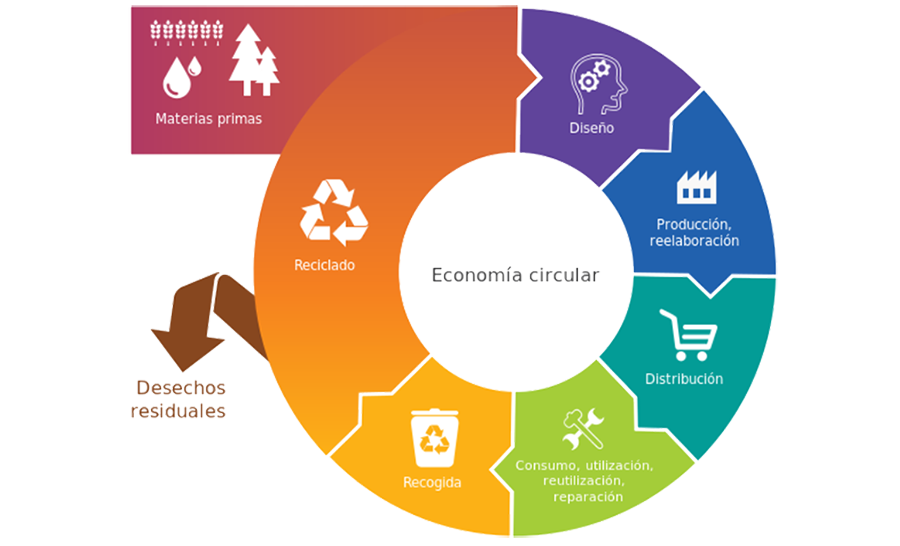
 Circular by design de la European Environment Agency. 2017 (PDF)
Disadvantagesof the linear economy
The traditional economic model, which is predominant in most of the world's nations, has played a fundamental role in economic development since the Industrial Revolution. However, it now stands at a critical juncture due in part to the evolution of the economy itself and to the new demands and needs of society, which form the bases of consumption.
International organisations specialising in the circular economy highlight a number factors that are leading to the replacement of the linear model by a circular one:
- Economic losses among companies.
- Volatility of resource prices.
- Interruptions in raw material supplies.
- Depletion or exhaustion of natural systems and reserves.
- Increased regulation.
- Increase in economic costs due to waste management and treatment.
Benefitsof the circular economy
Progressing towards a more circular economy —in line with European guidelines— will bring major benefits. These include a reduction in pressure on the environment, improvements in the supply security of raw materials, an increase in competitiveness and innovation and a growth in employment. Additionally, consumers in a circular economy have access to more durable and innovative products, with all the resulting financial savings.
By its very nature, the circular economy addresses the environmental challenges faced by society at large, by generating new business models and new jobs that will have a positive impact in reducing carbon emissions and the impact of climate change.
Economic advantages
- Increase in GDP
- Greater technological innovation
- Emergence of new business models and services
- Net savings in costs of materials
- Savings in consumer products
- Creation of job opportunities
- Reduction in consumption of resources in the economy
- Reduced dependency on imports of raw materials and greater supply security
- New forms of customer interaction and loyalty
- Greater competitiveness and sustainability
- Greater efficiency and productivity
- Greater profitability of products and processes
- Value creation
Environmental benefits
- Reduction in global emissions
- Reduction in waste generation
- Increase in value of land and soil as assets
- Reduction in the environmental impact of extraction processes
Newbusiness models
The transition towards a circular economy requires innovating business models that can replace or improve on existing ones. Business schools, international collaboration projects and government organisations are constantly creating new business opportunities with circular models based on eco design, resource recovery, extension of product life, servitization, shared use of platforms, industrial symbiosis and the use of renewable energy in their processes.
Other business models focus on correcting products and services as defined in the CIRC4Life project which seeks to narrow the gap between end users and the design and production phase, identifying preferences through the use of Big Data and Living Labs tools.
Here in the Basque Country, five priority areas of the circular economy have been identified for Basque industry, from the perspective of product innovation and optimal use of materials:
| Priority areas, circular economy in the Basque Country | |
| Product innovation | Optimised use of materials |
| Eco-design | Recycling of key waste metals |
| Remanufacture | Recycling of plastic waste, rubber and composites |
| Servitization | |
Product servitization is a business model whereby the user pays for access to the service providing a product, rather than owning the product itself. This approach has two objectives: to reinforce the production business and to develop a new line of business. Eco-design is an essential factor in moving towards that model, in that it extends durability.
Remanufacture ensures that products have a second life, with important savings in raw materials, water and energy, as well as all the associated environmental benefits.
Barriers
Reports such as the "Estudio Oportunidades de Negocio que ofrece el ecodiseño a las empresas de Euskadi [Study of Business Opportunities of Eco-design for Basque Companies], Fundación Orkestra, Ihobe, 2017" identify a number of barriers companies face in implementing more circular strategies or practices. The most important are in three areas:
- Innovation
- Investment and new business models
- Access to new markets and customer requirements
For example, the high cost of new innovation models makes it necessary for companies to seek alternative financing models — an aspect that is particularly difficult for SMEs.